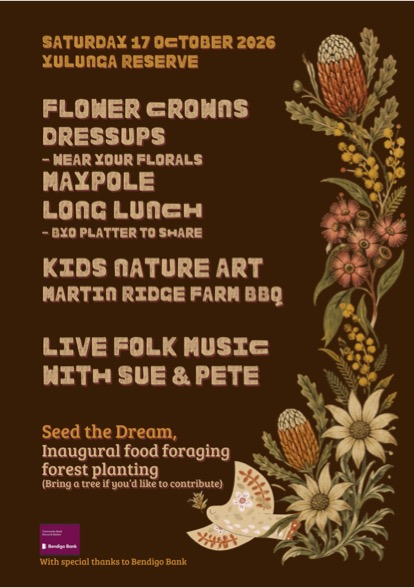
An old-fashioned spring festival: a maypole dance ribboning in the sunshine, a long lunch of local food down the middle of the oval, flower garlands, live music, children running free, and the planting of trees toward a community food forest.
It's a celebration of community for its own sake — but it's also more than that. The day is conceived as part of Origin, a free worldwide day of regeneration on 17 October, and our little festival will be filmed and shared to an audience of hundreds of thousands, showing off our community as the connected, nature-loving, regenerative place it is.
One tall pole for adults and big kids, a shorter one where little ones can circle and wrap freely.
Trestle tables running the length of the oval, dressed with flowers — local, seasonal and slow. BYO platter to share, with more to buy on the day from our local producers.
Garland- and flower-crown-making for dancers young and old, and colourful costumes to complement your breathtakingly floral outfits, threading through the whole day.
Fiddles and song — a spring festivity carried along by a steady walking-pace tune.
A community tree planting toward a local food forest — a place to forage for generations.
Our celebration captured for the Origin global hubcast — our community shared with the world.
If you're small, this day is yours. A shorter maypole just for little hands, dress-ups, garlands and flower crowns, nature-based craft and painting, a tree of your own to plant, and a whole oval to run on.
Make your own roadside sign to help keep our wildlife safe. Old election corflutes (with thanks to the Shoalhaven Greens) get a second life as bespoke signs, painted with Surfpaint acrylic markers and water brushes. All ages welcome, with parents and kids creating side by side.
Find the Greens marquee for free information, petitions and stickers, and take home a native seedling to grow something good in your own patch.
Little nature lovers can colour in and collect stickers celebrating the Great Southern Forest, the vision for protecting the tall forests and wildlife on our doorstep.
Voices raised together under the sky, no experience needed, just the joy of singing in a circle.
Because in the end this whole day is about them: the children planting trees they'll forage from as grown-ups, and learning that a community is something you make together.
The maypole is the heart of the day — the literal weaving-together of community, and a tradition celebrating spring, fertility and the return of life to the land. It needs no fitness, no experience and no rehearsal beyond a few minutes of practice; it suits every age; and the finished lattice of ribbons woven down the pole is a small work of art made by everyone together.
Ribbons held loosely, everyone walks the circle one way to the music, then reverses, finding the rhythm together.
Number off 1s and 2s. The 1s face clockwise, the 2s anticlockwise. Pass the first dancer on the right (ribbon over), the next on the left (duck under): over, under, over, under. A diamond lattice weaves down the pole.
Stop, turn around and reverse the pattern to unwind — or keep weaving until the ribbons run short and tie them off as a keepsake.
Maypole dancing evolved from an ancient custom recorded as early as Roman times, when people tied ribbons to a tree and danced around it. The first British record dates to 1350, when a tall birch pole decorated with ribbons and flowers was raised at Llanidloes in Wales, with musicians playing for the dancers.
The Puritan parliament banned maypoles in 1644 as 'a heathenish vanity', trying to stamp out what had been part of May Day (Beltane) celebrations welcoming summer. When the monarchy was restored, a vast decorated maypole went up in London in 1661 for all to enjoy. The braiding of maypoles with coloured ribbons only began in the 19th century, standardised by John Ruskin at a London teacher-training college — which is how maypole dancing found its way into schools across the land, and why so many villages kept a maypole at their centre for festivals and fetes.
Today it's a traditional folk dance: not so commonly seen, great fun, no fitness required, and suitable for absolutely all ages. (Source: maypolehire.com)
Trestle tables end to end, running with flowers, set for 180 — and BYO picnic blanket. Please bring a platter to share, because this is a FEAST. Martins Ridge Farm, Lagom Bakery, Sussex Greenhouse and R&R Food and Bev will all be with us to supplement your feasting.
The food will be guided by Slow Food principles — good, clean and fair food that connects us to the people who grow it. We're lucky to have Slow Food Berry to Jervis Bay here in the Shoalhaven guiding our approach.
Local, local, local.
Flowers thread through the whole day — garlands and crowns for the dancers, blooms along the tables, and the maypole's flowered crown. We're planning a run to the Sydney Flower Markets at Homebush to gather armfuls in bulk. Flowers aren't just decoration; they lift the spirit and heal in ways science is only beginning to describe.
Discover moreA spring festivity needs music, and ours comes from locals Sue & Pete of Harvest Bar fame — fiddles and song carrying the day along at a steady walking pace.
Seed the Dream is a wonderful part of Origin: communities all over the world planting trees on the same day. Here, we'd plant out a community food forest — a place to forage and gather for generations. Everyone attending could bring a tree to contribute, and the children will plant the first of them.
Discover moreOrigin is a worldwide day highlighting regeneration, with projects and celebrations happening across the globe. Origin has offered to film our celebration and share it — a rare opportunity to showcase our humble community as a regenerative, nature-loving, integrated place.
Footage and kudos that strengthen our hand when we resist inappropriate development, apply for grants, and make the case for this community as somewhere worth investing in and protecting.
Discover OriginStalls on the day from Manyana Matters, the Great Southern Forest campaign and The Greens.
Sourcing and preparing the pole(s), crown and ground sleeve.
Loud, joyful voices to teach the weave on the day.
The market run, garland-making, dressing the tables and the crown.
Calling all sewers and craftspeople to join our workshops.
Fiddles, guitars, voices.
Coordinating Seed the Dream and the food forest planting.
Face painting, flower crowns, games on the oval.
Table and chair set-up, rubbish and composting, and taking photos.
If any of this makes your heart sing — or you know someone whose heart it would make sing — please get in touch.