Tīrtha · Genius Loci · Power Spot · Thin PlaceA place where the boundary between ordinary and sacred becomes navigableA location on earth where the natural energetic field is so concentrated, coherent, or alive that it amplifies consciousness, accelerates healing, and intensifies spiritual practice — not because of what we bring to it, but because of what the place itself already is.
Every human culture, on every continent, in every era, has identified certain places as different. Not beautiful in the ordinary sense — though many are — but different in a way that resists aesthetic explanation. Places where prayer feels like it travels further. Where meditation deepens more readily. Where the body settles into a quality of stillness it cannot find elsewhere. Where something that is normally background — the sense of a larger presence, or a finer quality of attention — moves to the foreground and becomes undeniable.
These places have been named differently across traditions. The Vedic tradition calls them tīrthas — crossing places, fords, locations where the transition from one realm of reality to another is navigable. The Celtic tradition calls them thin places — where the membrane between the visible and invisible worlds is unusually permeable. The Chinese tradition maps them through feng shui — the art of reading the flow of qi (life force) through the landscape and identifying nodes where it concentrates with unusual intensity. Indigenous traditions across the Americas, Africa, and Australia speak of power spots: places where the spirit of the land (genius loci) is so fully present that it can be felt, worked with, and asked for help.
The modern term vortex — borrowed from physics and applied to these energetic concentrations — captures something the older language sometimes obscures: the quality of movement. A vortex is not static. It is a dynamic spiralling of energy around a central axis, a concentration that is also a flow. Sacred vortex sites are not simply charged places — they are places where energy is in continuous, purposeful motion, where the subtle forces that underlie physical reality are gathered and active in a way that can be felt, and worked with, by any sufficiently attuned practitioner.
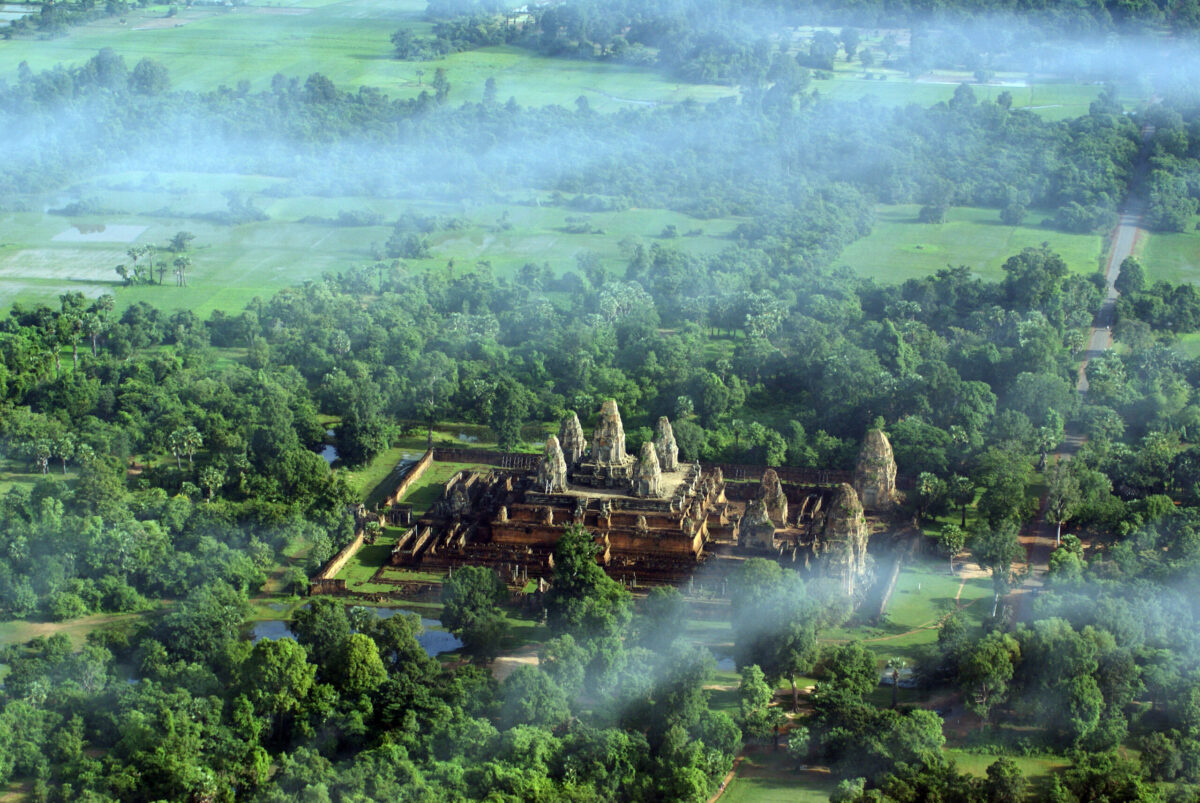
The SoulAdventure retreats at Angkor Wat are located at one of the most unambiguously powerful such places on earth — a site that was engineered as a vortex by its builders, maintained as one by nine centuries of continuous practice, and confirmed as one by the independent testimony of every contemplative tradition that has encountered it.
“There are places on earth that remember what we have forgotten — that carry within their stone and water and light the accumulated knowledge of every prayer that has ever been offered in them. To enter such a place is not to visit history. It is to be received by it.”
— SoulAdventure — Sacred Sites
One phenomenon, many names — the vortex across traditions
Cross-cultural recognition — the universal patternEvery tradition has a word for itThe independent, convergent recognition of energetically active places across cultures separated by thousands of years and thousands of kilometres is itself one of the strongest arguments that the phenomenon is real
Vedic / Hindu
Tīrtha (तीर्थ)
Literally a ford or crossing place — a location where the boundary between the earthly and divine realms is thin enough to cross. Tīrthas include rivers, mountains, temples, and specific sites where deities have manifested or sages have attained enlightenment. Pilgrimage to a tīrtha is understood to purify karma and accelerate spiritual progress precisely because of the energetic quality of the location. The entire tradition of Hindu pilgrimage (yātrā) is built on this understanding.
Celtic / Druidic
Thin Place
The Celtic concept of a thin place (often found at the intersection of land, water, and sky — cliff edges, river sources, hilltops) describes a location where the veil between the seen and unseen worlds is so attenuated that communication and passage between them becomes possible. Celtic sacred sites (Glastonbury, Iona, the Hill of Tara) were chosen and maintained precisely because of their thinness, and the annual calendar (Samhain, Beltane) identified the moments when the veil thins for everyone, everywhere.
Chinese / Taoist
Qi node (氣穴)
In the Chinese geomantic system of feng shui, qi (life force) flows through the landscape along pathways called dragon veins (lóng mài). Where these pathways intersect, pool, or concentrate, qi accumulates with unusual intensity — creating nodes that are auspicious for temples, tombs, and sacred practice. The siting of Chinese temples, imperial tombs, and even cities was guided by centuries of feng shui observation aimed at identifying and utilising these qi nodes. The practice of observing how water, wind, and terrain channel invisible energy through a landscape is one of the most sophisticated geomantic traditions on earth.
Indigenous / Shamanic
Power Spot
Across the indigenous traditions of the Americas, Africa, Australia, and Siberia, the landscape is understood to be inhabited by spirits — and certain places are understood to be where those spirits are particularly concentrated, active, or accessible. Power spots are locations identified through direct spiritual perception — shamans in training are often sent to sleep in different places in the landscape until they find the spot where their dreams are most vivid and teaching most clear. These sites are then maintained through ceremony, offering, and the accumulated presence of generations of practitioners.
Roman / Western
Genius Loci
The genius loci — the spirit of a place — was a formal element of Roman religious understanding. Every significant place had its genius: a tutelary spirit that animated it, gave it its characteristic quality, and needed to be properly honoured by those who worked or lived there. The Roman practice of establishing a shrine to the genius loci of a new settlement before building anything else reflects an understanding that the spirit of a place is not a projection of human imagination but an actual presence to be reckoned with.
Buddhist
Sacred Mountain / Pilgrimage Site
Buddhist tradition identifies specific places as naturally conducive to awakening — locations where the Buddha or great bodhisattvas practiced, attained realisation, or taught. Beyond historical association, certain landscapes (particularly mountains) are understood as inherently sacred: Mount Kailash is simultaneously sacred to Hindu, Buddhist, Jain, and Bon traditions, suggesting its power transcends any single theological framework. The Buddhist practice of circumambulation (walking around a sacred site in the clockwise direction) is understood to attune the practitioner's energy to the site's field.
Modern / Geomantic
Ley Line / Earth Chakra
The 20th-century concept of ley lines — straight alignments of ancient sacred sites across the landscape — was proposed by Alfred Watkins in 1921 and developed by subsequent researchers into a global geomantic framework. The idea that the earth has an energetic grid, with major vortex nodes at the intersections of these lines, has become widespread in the global spiritual community. The concept of earth chakras — specific sites (Uluru, Glastonbury, Angkor, the Himalayas) understood as the chakric energy centres of the planet's subtle body — maps the individual chakra system onto the body of the earth itself.
Three types of vortex energy
⚡Type oneElectric VortexSites where upward-moving energy is predominant — associated with heightened mental activity, inspired thinking, visionary states, and the activation of masculine or solar qualities. Often found at rocky peaks, exposed ridgelines, and sites of geological uplift. Practitioners report increased alertness, creative vision, and mental clarity. Best worked with through active practices: mantra, pranayama, movement, intention-setting, and ceremony.
🌊Type twoMagnetic VortexSites where downward or inward-drawing energy is predominant — associated with deep grounding, emotional processing, surrender, and the activation of feminine or lunar qualities. Often found near water sources, in valleys, at cave entrances, and in ancient forest. Practitioners report deep relaxation, release of emotional holding, access to unconscious material, and profound receptive states. Best worked with through receptive practices: meditation, deep listening, silent sitting, and restorative bodywork.
✦Type threeElectromagnetic VortexThe rarest and most powerful type — sites where both upward and downward energies are active simultaneously, creating a dynamic, spiralling field that is simultaneously activating and grounding. These sites are associated with the full range of transformative experience: spiritual vision, emotional breakthrough, physical healing, and non-ordinary states of consciousness. Angkor Wat is understood as an electromagnetic vortex of this type — simultaneously activating and containing, both solar and lunar, a complete field in itself.
What the research showsThe science of energetically anomalous places
The scientific study of sacred sites is young but already producing interesting findings. The field of archaeoacoustics — which studies the acoustic properties of ancient sites — has found that many of the world's most significant sacred spaces were constructed with deliberate acoustic design: resonant chambers, standing wave frequencies at or near 110 Hz (which research associates with altered states of consciousness), and reflection geometries that create immersive sonic environments. Angkor Wat's sandstone galleries exhibit measurable acoustic properties that distinguish them from ordinary stone enclosures.
Geomagnetic research presents the most potentially significant findings. Studies by researchers including John Burke and Kaj Halberg (published in Seed of Knowledge, Stone of Plenty, 2005) measured electromagnetic anomalies at dozens of ancient sacred sites across Europe and the Americas. They found that many sites — particularly stone circles and ancient temples — sit above deposits of paramagnetic rock that concentrate the earth's magnetic field in measurably unusual ways. They also found that seeds germinated in these fields showed statistically significant changes in growth rates, suggesting that the fields produce real biological effects. A 2019 study published in the Journal of Scientific Exploration found measurable neurological correlates — changes in EEG patterns — in subjects meditating at acknowledged vortex sites compared to control locations nearby.
None of this definitively explains what practitioners mean when they say a place is sacred. But it opens a genuinely interesting question: if the earth's magnetic field influences biological systems, and if ancient sacred sites systematically sit at points of unusual geomagnetic concentration, then the millennia-long human practice of identifying and gathering at these places may reflect an intuitive sensitivity to real physical phenomena — a kind of geomagnetic navigation that precedes and transcends any theological framework. The sacred and the scientific may be mapping the same territory from different directions.
The world's most recognised sacred vortex sites
Site
Tradition & vortex type
What makes it exceptional
Angkor Wat ✦Siem Reap, Cambodia
Hindu · Buddhist · Electromagnetic vortex
A 12th-century stone cosmogram explicitly engineered as Mount Meru — the cosmic axis. Equinox-aligned. Nine centuries of continuous prayer. Unusual sandstone paramagnetic properties. The only sacred site on earth where the vortex intention was encoded in the architecture itself at the moment of construction. SoulAdventure retreat site.
Glastonbury TorSomerset, England
Celtic · Arthurian · Magnetic vortex
The legendary Isle of Avalon — one end of the Michael and Mary ley lines that cross southern England. A natural hill whose terraced sides may represent a three-dimensional labyrinth of ancient ceremonial significance. Strong dowsing responses. The spring at the base (Chalice Well) has produced a constant flow of iron-rich water for at least two millennia.
SedonaArizona, USA
Native American · New Age · Electric vortex
Red sandstone formations with anomalously high paramagnetic content — among the highest measured at any terrestrial site. Four major vortex sites identified by local indigenous knowledge and confirmed by independent dowsers: Bell Rock (electric), Cathedral Rock (magnetic), Airport Mesa (electric), and Boynton Canyon (electromagnetic). Measurable compass deflection in several locations.
Mount KailashTibet, China
Hindu · Buddhist · Jain · Bon · Electromagnetic
The only major sacred mountain simultaneously claimed by four independent religious traditions — a cross-cultural convergence that suggests a quality of the place itself rather than any single tradition's projection. Its 52-km circumambulation (kora) is understood to erase the karma of a lifetime. No human being is known to have climbed it — a prohibition maintained by all four traditions.
Uluru (Ayers Rock)Northern Territory, Australia
Anangu · Aboriginal · Magnetic vortex
A 348-metre sandstone monolith understood by the Anangu people as one of the oldest living sacred sites on earth — a record of the Dreaming, the time of creation, encoded in rock. Measurable geomagnetic anomalies. Climbing was prohibited by the Anangu and formally closed to visitors in 2019. The sunset colour changes — from ochre to violet to deep red — are understood as a visible expression of the site's energetic activity.
Machu PicchuCusco Region, Peru
Incan · Andean · Electromagnetic vortex
Positioned at the intersection of two mountain ridges, at the confluence of two rivers, and precisely aligned to the summer solstice sunrise — the Intihuatana stone ("hitching post of the sun") is understood as a device for concentrating and anchoring solar energy at the site. The Andean tradition of apus (mountain spirits) identifies specific peaks at Machu Picchu as living spiritual presences who can be called upon for guidance and healing.
Varanasi / KashiUttar Pradesh, India
Hindu · Continuous tīrtha
The oldest continuously inhabited city on earth and the supreme tīrtha of the Hindu tradition — the crossing place where Shiva himself is said to reside. The Ganges at Varanasi is understood as the concentrated form of all sacred waters on earth. To die in Kashi is understood to guarantee liberation — the city itself confers moksha regardless of the spiritual attainment of the individual. Millions of pilgrims have prayed here continuously for at least 3,000 years.
How to work consciously with a sacred vortex
Arrive emptyReceptivity before intentionThe most common mistake practitioners make at sacred sites is arriving with a dense agenda — a long list of intentions, a specific healing they need, a particular question they need answered. A vortex site works most powerfully when the practitioner arrives in a state of genuine openness — willing to receive what the site offers rather than extract what the practitioner wants. The first practice at any vortex is simply to arrive, sit down, and listen.
Attune before practiceCalibrate to the fieldEvery sacred site has its own frequency, rhythm, and quality of presence. Before beginning any formal practice — mantra, meditation, breathwork — spend time simply attuning to the site's energy. Walk the space slowly. Touch the stone or earth. Observe how the body responds in different locations within the complex. Different spots within the same site often carry markedly different qualities. Find the spot where the body settles most naturally.
Sound amplifies the fieldMantra as activationMantra and kirtan work synergistically with vortex energy in a way that silent meditation alone does not. Sound is itself a vibrational phenomenon — and when it is introduced into a site that is already vibrationally active, the two fields interact. The site amplifies the mantra; the mantra amplifies the site's energy; both are amplified in the practitioner's body. This is why sacred sound practices have been central to pilgrimage and temple culture in every tradition that works with sacred sites.
Honour with offeringReciprocity as protocolEvery major tradition that works with sacred sites includes the practice of offering — flowers, incense, water, food, prayer, song, or simply gratitude consciously expressed. The offering is not payment for a service but an acknowledgement of a relationship. When a practitioner arrives at a vortex site and simply takes — takes the heightened energy, takes the deepened meditation, takes the vision or healing — without acknowledging the place as a subject in its own right, the relationship is extractive rather than relational. Offer something. It need not be elaborate.
Work with timingEquinox, solstice, sunriseSacred vortex sites are not uniformly powerful across all times. They have their own rhythms — daily (sunrise and sunset are peak moments at most sites), lunar (full and new moon), and solar (equinox and solstice). The astronomical alignments built into ancient temples were not decorative — they encoded the knowledge of when the site was most energetically active. Angkor Wat's equinox alignment, for example, marks a moment when the site's field is measurably heightened and the practice conducted within it correspondingly amplified.
Integrate before leavingGround what you receivedVortex experiences can be disorienting — not because they are harmful, but because they can temporarily loosen the ordinary anchors of identity and perception. Before leaving a powerful sacred site, take time to ground: eat something, walk on the earth, write what you noticed, speak to a companion about your experience. The energy received at a sacred site is most useful when it is integrated into the life you are actually living — not left as a floating transcendent experience disconnected from your daily reality.
Key terms in sacred site and vortex practice
Tīrtha (तीर्थ)
Sanskrit for a ford, a crossing place — a location where the transition between the earthly and divine realms is navigable. From the root tṝ (to cross, to get through). The entire tradition of Hindu pilgrimage (yātrā — journey) is organised around the concept of tīrtha: specific places where the accumulated spiritual power of the site, amplified by the prayers of all who have visited before, makes the divine especially accessible. Angkor Wat functions as a tīrtha for the traditions of both Hinduism and Buddhism.
Genius Loci
Latin for the spirit of a place — the tutelary presence that animates a specific location and gives it its characteristic quality. The Roman tradition of propitiating the genius loci before any significant activity on new land reflects an understanding that the spirit of a place is an actual presence to be acknowledged and worked with, not a projection of human imagination. The quality that makes a vortex site feel alive — as though it is paying attention — is the genius loci made palpable.
Paramagnetism
A physical property of certain materials (including specific types of basalt, granite, and sandstone) to become weakly magnetised in the presence of an external magnetic field. Research by Phil Callahan and others has found that many ancient sacred sites — particularly stone circles and ancient temples — were constructed from or positioned on deposits of highly paramagnetic rock. The hypothesis is that ancient builders, through direct energetic perception, identified locations where this property concentrated the earth's field in ways that affected biological and neurological systems.
Ley Line
A proposed alignment of ancient sacred sites across the landscape, first systematically described by Alfred Watkins in 1921 and developed into a global geomantic framework by subsequent researchers. The Michael and Mary ley lines crossing southern England connect Glastonbury, Avebury, Stonehenge, and dozens of other ancient sites in a single straight alignment. Whether ley lines represent physical energy pathways, astronomical sight lines, ancient trackways, or a combination of all three remains genuinely contested — and genuinely interesting.
Yātrā (यात्रा)
Sanskrit for journey, pilgrimage — specifically the sacred journey undertaken to visit a tīrtha. The journey itself, not only the destination, is understood as spiritually significant: the difficulty, the distance, the surrendering of ordinary life and comfort, the accumulating devotion of each day on the road. Many yātrā traditions specify that the approach to a sacred site should be made on foot, precisely because the gradual journey allows the pilgrim to match their internal state to the energetic quality of the destination.
Archaeoacoustics
The scholarly study of the acoustic properties of ancient sacred sites — exploring the hypothesis that ancient builders deliberately designed their structures to produce specific acoustic effects. Research in this field has found measurable resonant frequencies at sites including Stonehenge, Maltese megalithic temples, and Mexican pyramids, often clustering near 110 Hz — a frequency that research associates with shifts in neural activity. The application of archaeoacoustics to the galleries of Angkor Wat is an active and productive area of current research.
Circumambulation
The ritual practice of walking in a circle around a sacred site or sacred object — present in Hindu (pradakṣiṇā), Buddhist (kora), Islamic (tawāf around the Kaaba), and many indigenous traditions. The clockwise direction (following the sun's apparent movement) is most common, aligning the practitioner's movement with the larger cosmic movement. Circumambulation is understood not merely as a physical action but as an energetic one: walking the perimeter of a vortex site is understood to attune the practitioner's field to the site's field through resonant proximity.
The vortex you can visitWhy Angkor Wat is SoulAdventure's sacred site
Among the world's recognised vortex sites, Angkor Wat holds a particular place: it is the only major sacred site on earth where the vortex was explicitly and consciously engineered by its builders. Every other recognised vortex was discovered at a naturally occurring energetic anomaly — a geological fault, a paramagnetic rock formation, a hydrological convergence — and then worked with, amplified by ceremony, and maintained by practice. Angkor Wat was different. Its architects, drawing on a cosmological tradition that understood the laws of sacred geography with precision, chose this specific location and then built a structure designed to concentrate, channel, and amplify the site's natural energy.
The result, nine centuries later, is a site where the natural energetic qualities of the Cambodian landscape, the cosmological design of the temple complex, and the accumulated devotion of millions of practitioners across multiple traditions have fused into something that consistently produces powerful experiences — not for a select few with unusual sensitivity, but for a broad range of visitors who arrive with even basic receptivity. The stone galleries amplify mantra in ways that are immediately perceptible. The pre-dawn hours produce states of meditation that experienced practitioners describe as among the deepest available anywhere. The equinox alignment, still precise after 900 years, connects practitioners to a celestial timing that operates far beyond any human schedule.
Both SoulAdventure retreats at Angkor are designed specifically to work with these qualities — not simply to visit a beautiful historic site, but to use the vortex energy of Angkor Wat as an active partner in the transformation the retreat is designed to facilitate.
Experience a sacred vortex on retreat
8-day gathering · Jan 3–10, 2027The AngkorConvergence
January 3–10, 2027 · Siem Reap, CambodiaEight immersive days at one of earth's most powerful vortex sites — combining temple pilgrimages, sacred water traditions, sound healing, and conscious collaboration with spiritual leaders, artists, and cultural visionaries. Presented with Unity Earth and World Weavers. Maximum 70 participants.
5-day mantra retreat · Mar 10–14, 2027Renata Sarasvati Diem — Mantra & Resonance
March 10–14, 2027 · Angkor Grace, CambodiaFive days of mantra, Kriya Yoga, and sound healing with Vienna Conservatory-trained healer Renata Sarasvati Diem — using the vortex energy of Angkor Wat's stone galleries as an active partner in vocal awakening and spiritual transformation. Sunrise temple pilgrimage included.
Seminar only — $570Shared suite — $750Private suite — $995
About this termA sacred vortex is a location where the earth's energetic field is understood to be unusually concentrated or active — amplifying consciousness, accelerating healing, and intensifying spiritual practice. Known across traditions as tīrthas (Vedic), thin places (Celtic), qi nodes (Chinese), power spots (indigenous), and genius loci (Roman), these sites have been independently recognised by virtually every human culture throughout history. Angkor Wat — the site of SoulAdventure's Cambodian retreats — is one of the most documented and consistently reported sacred vortex sites on earth.