Sacred Sites — SoulAdventure Glossary
Glossary — Sacred Geography

Sacred Sites

5 terms  ·  Temple complexes  ·  Vortexes  ·  Pilgrimage  ·  Astronomical alignments The world's most charged places — built to mirror the cosmos, worn smooth by nine centuries of bare feet, and still alive with the resonance of every prayer that ever rose in them. A living glossary of sacred geography for practitioners of mantra, yoga, and contemplative pilgrimage.
5 Core glossary terms
900+ Years of continuous use at Angkor
2 Retreats at Angkor Wat, 2027
Accumulated devotion

Every spiritual tradition on earth identifies certain places as more alive than others. Not metaphorically — experientially. Practitioners across centuries, cultures, and belief systems report the same phenomena in the same locations: a quality of stillness that is also alert, a silence that feels inhabited, an ease of attention that weeks of ordinary meditation rarely achieve. Whether you understand this through the lens of geomagnetic field anomalies, accumulated shakti, the memory of millions of prayers, or the simple gravitational pull of beauty, the effect is the same: some places make it easier to go inward.

The five terms in this glossary — Angkor Wat, sacred vortex, pilgrimage, temple complex, and equinox & solstice alignments — are the conceptual vocabulary of sacred geography. Together they describe where the sacred is housed, how it is encoded in stone and water and astronomical orientation, and what it means for a practitioner to journey toward it deliberately.

Interactive knowledge map — sacred sites & related practice

Concept network — click any node to explore How the five terms connect Each sacred-site term links to related glossary concepts and retreat offerings — hover to preview, click to navigate
Sacred Sites Knowledge Graph An interactive node graph showing the five sacred-site glossary terms — Angkor Wat, Sacred Vortex, Pilgrimage, Temple Complex, and Equinox/Solstice — orbiting a central Sacred Sites hub, with edges connecting to related practice terms and retreat links. Mantra sound Kirtan chant Angkor Convergence Meditation practice Chakra energy Bhakti yoga Dharma order Pranayama breath Nada Yoga resonance Sanskrit language Sound healing Angkor Wat temple Sacred Vortex energy Pilgrimage journey Temple Complex architecture Equinox & Solstice alignment Sacred Sites 5 terms

The five terms — gateway definitions

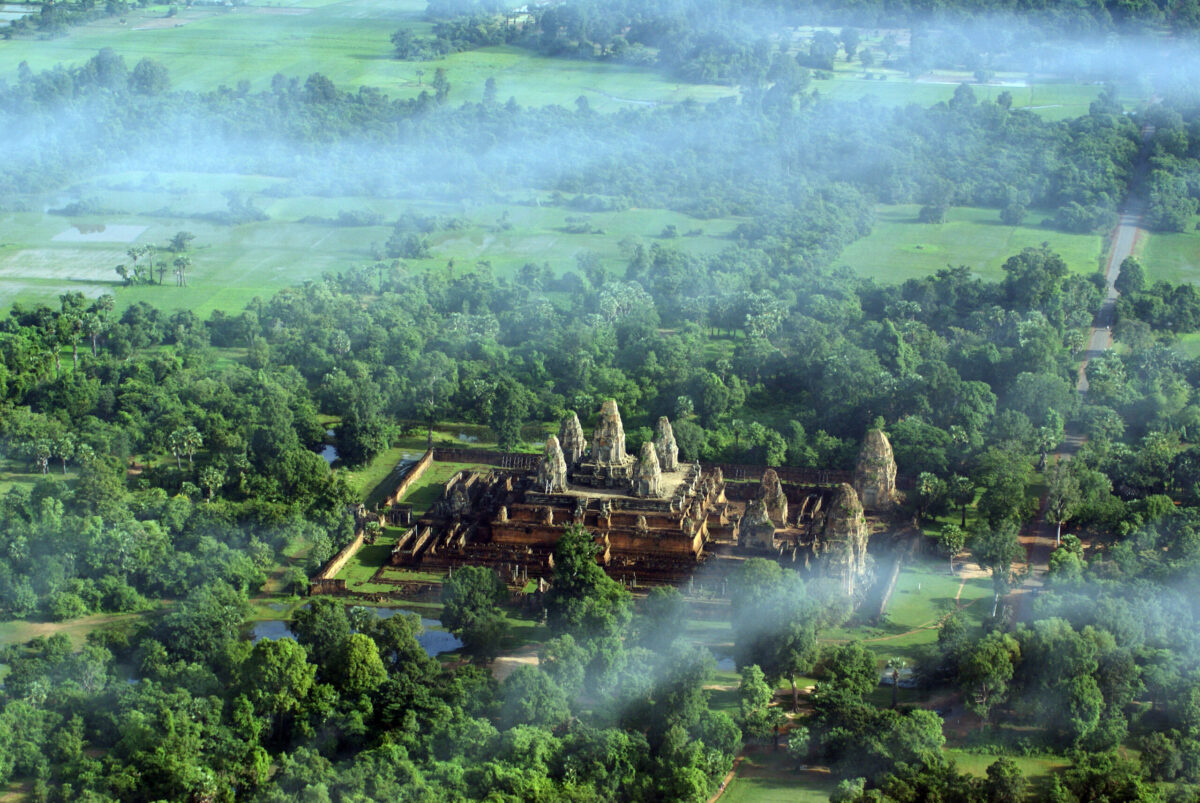
The largest religious monument on earth — a 12th-century stone cosmogram built by the Khmer king Suryavarman II in what is now northwestern Cambodia. Dedicated to the Hindu god Vishnu and later adopted as a Theravada Buddhist sanctuary, it was constructed as a three-dimensional mandala: a stone map of the sacred universe, with its central tower representing Mount Meru (the cosmic axis), its galleries representing the mountain ranges of the cosmos, and its moat representing the primordial ocean. For practitioners of mantra, kirtan, and contemplative pilgrimage, Angkor Wat is one of the most acoustically and energetically charged sacred sites on earth — a sandstone instrument built for sacred sound and charged with nine centuries of unbroken devotion.
Full entry →
A location where the earth's subtle energy field is particularly concentrated, coherent, or directionally active — experienced by sensitive practitioners as heightened clarity, accelerated inner work, reduced mental noise, or an unusual quality of aliveness. Vortex sites span every tradition and every continent: Sedona's red rock formations, the summit of Adam's Peak in Sri Lanka, the Bön sacred mountain of Kailash, the confluence of rivers at Prayagraj, the spring at Lourdes. In the Hindu framework, these are shakti-pithas — seats of the Goddess's power. In the Taoist tradition, they are nodes on the earth's lung mei (dragon veins). In Andean cosmology, they are apus — spirit mountains. The words change; the experience reported at these sites across all traditions remains strikingly similar: a place where the inside and the outside become less separate.
Full entry →
The act of journeying to a sacred place as a form of devotional practice — one of the oldest and most universal forms of spiritual engagement across every world tradition. Pilgrimage is not tourism with a pious intention. The journey itself is the practice: the leaving of ordinary life, the physical challenge of travel, the relinquishment of comfort, the focus on a single sacred destination — all of this strips away the habitual layers of identity and leaves the pilgrim unusually available to encounter. In the Hindu tradition, this is called tirtha-yatra (crossing to the sacred ford). In Islam, the Hajj. In Tibetan Buddhism, the kora (circumambulation of a sacred mountain). In the Christian tradition, the Camino de Santiago. The movement of the body through space toward the sacred has been understood across all traditions as one of the most reliable means of opening the heart. SoulAdventure's retreats are designed as contemporary pilgrimages — with the full intention and transformative depth the word implies.
Full entry →
A collection of sacred structures — shrines, gateways, processional routes, sacred tanks, colonnaded halls, and tower-sanctuaries — built to mirror cosmological order and create conditions for encounter with the divine. The temple complex is never merely a building. In the Vedic tradition, a temple is a body: the main sanctuary (garbhagriha — literally womb-chamber) is the heart, the tower (shikhara or prasat) is the spine reaching toward heaven, the surrounding halls and colonnades are the limbs. To move through a temple complex is to move through an anatomical and cosmological map simultaneously. At Angkor Wat, this is expressed at a scale — 162 hectares — unmatched anywhere on earth. The complex includes the main temple, four library buildings, reflecting pools, a 5.5 km moat, and processional causeways flanked by serpent (nāga) balustrades that function as rainbow bridges between the ordinary world and the sacred interior. To understand temple complexes is to understand why Nada Yoga and pranayama work differently inside them than they do in an ordinary room.
Full entry →
The astronomical events at which sacred sites across the world reveal their deepest intentional orientation — sunrise shafts piercing temple sanctuaries, shadow patterns encoded by architects nine centuries dead, solstice sunsets aligned to tower peaks that still stand to receive them. Every major ancient sacred site was oriented with astronomical precision: Stonehenge at the summer solstice, the Great Pyramid at the spring equinox, Chichen Itza's El Castillo at both equinoxes (the famous serpent of shadow descending the staircase), Newgrange's inner chamber illuminated only at the winter solstice dawn. At Angkor Wat, the spring equinox sunrise rises directly over the central tower as seen from the main causeway — a sight that 12th-century architects calculated to be possible from a specific standing point, encoding astronomical truth in geography for as long as the stones stand. For practitioners, these alignments are not merely spectacular: they are the moments when the sacred site's full intention is activated, when its builders' cosmological understanding is most legible, when the encounter between the human body, the built sacred space, and the movement of the cosmos is most direct.
Full entry →
“Sacred sites are not where God is hidden — they are where the veil between human and divine has been worn thin by the weight of every prayer that has ever risen in them. To stand in them is to stand in the company of every practitioner who has ever stood there before you.” — SoulAdventure  ·  Sacred Geography Series

SoulAdventure retreats at Angkor Wat — 2027

8-day gathering · January 3–10, 2027 The AngkorConvergence
Where spiritual teachers, social entrepreneurs, peacebuilders, and cultural visionaries converge at the most powerful sacred site in Southeast Asia. Temple pilgrimages, sacred water ceremonies, sound healing, and strategic visioning for a world in transition. Presented in collaboration with Unity Earth and World Weavers.
Twin — $1,980 Single — $2,550 Deposit — $500
Reserve a place →
5-day mantra retreat · March 10–14, 2027 Renata Sarasvati Diem — Mantra & Resonance
Five days of sacred sound, mantra, and healing at Angkor Wat under the guidance of Vienna Conservatory-trained opera singer and sacred healer Renata Sarasvati Diem. Mantra singing, Kriya Yoga, Pranayama, crystal bowl sound healing, and sunrise temple pilgrimage at the March equinox.
Seminar — $570 Shared suite — $750 Private suite — $995
Discover the retreat →
A note on sacred geography What makes a site sacred — and why it matters for practice

The most parsimonious answer is also the most useful: a place is sacred when human beings have consistently found it so. This is not circular — it is empirical. The traditions that built the great sacred sites were in most cases sophisticated astronomers, geomancers, and acoustic engineers. They chose their sites not arbitrarily but after long observation of which places supported altered states, healing, vision, and encounter with the non-ordinary. They then built structures that amplified whatever they found there — orienting them to astronomical events, shaping their chambers to resonate specific frequencies, dressing them with images that taught the sacred narratives to every pilgrim who passed through.

The result is a category of place that functions as a spiritual technology. Not because of magic, but because of accumulated intention, architectural intelligence, acoustic design, and the genuinely measurable geomagnetic anomalies that cluster at sites that have been identified as sacred across multiple independent traditions. Angkor Wat sits at the centre of a water management system of extraordinary sophistication. Its moat is not decorative — it is a mechanism for regulating the groundwater that keeps the sandstone from shifting. The builders understood hydrology, astronomy, acoustics, and sacred geometry simultaneously, and their site choice reflected all four. To practice in such a place is to benefit from every layer of that intelligence at once.

This glossary is designed to give practitioners the conceptual vocabulary to engage with sacred sites consciously — not as tourists who happen to meditate, but as pilgrims who understand what they are standing in. The five terms here are the beginning. Every retreat SoulAdventure offers at a sacred site is designed with this understanding at its core: pilgrimage as practice, mantra as activation, and the ancient stones as collaborators.
About this glossary section The Sacred Sites section of the SoulAdventure Glossary covers five foundational concepts in sacred geography: Angkor Wat (the largest religious monument on earth), Sacred Vortex (earth energy concentrations), Pilgrimage (devotional journey as practice), Temple Complex (cosmological architecture), and Equinox & Solstice Alignments (archaeoastronomy). SoulAdventure offers two immersive retreats at Angkor Wat in 2027: The AngkorConvergence (January 3–10) and the Renata Sarasvati Diem Mantra Retreat (March 10–14).
Related glossary terms & practice pages